A steadier way to get found than one directory listing.
When most of your new clients come from a single directory, a few local referral relationships give you a second, quieter source you actually control. This kit is what therapists use to start those conversations with local doctors and other providers. Everything is already written. You fill in your name, your niche, and how to reach you, then send it.
By Jesse, Registered Psychotherapist.
Who this is for
Built to match where your practice actually is
One question worth sitting with first: do you know whether your current visibility is plateauing, or still building? If you're not sure, the free practice checkup is the faster starting point. If you already know your main channel is tapped out and you've been meaning to build something local and relationship-based, this kit is what makes that concrete.
I work with therapists at both ends of this. If you're mostly full and just want one or two steady right-fit relationships, the kit gives you a way to be specific about exactly who you want sent your way. If you're at two clients and building, it gives you a low-pressure way to become the person nearby doctors think of. Either way, your niche is what decides who you contact.
Your niche decides who you contact. A perinatal therapist walks into OB and midwifery offices. Someone doing OCD or trauma and EMDR talks to psychiatry and primary care. A neurodivergent-affirming practice reaches pediatricians, school counselors, and neurologists. The kit is written so you name your niche in plain terms and it points you at the right doors. It does not assume generic therapy.
If you are telehealth-only with no local office to walk into: Nothing here requires showing up in person. The intro email and the mailable letter do the same job as the in-person drop-off, so you can start these relationships without a waiting room to visit.
If you run a group practice: This is built around one clinician, so group practices typically start with the two or three therapists whose caseloads most need filling. Each kit is specific enough that a referring office knows exactly which of your therapists fits the patient in front of them, instead of routing everyone to a general intake line. The front-desk script already matches how a multi-provider office handles that handoff.
And one thing worth naming for specialty practices: the one-pager has blanks, not pre-written sentences. You write your own niche description, your own good-fit list, your own not-a-fit line, so precise practice language survives intact instead of getting flattened into "anxiety therapist." And if the part you're dreading is the moment at the front desk, that's the exact moment the script is written for. You read it, you hand over the sheet, you leave.
What's inside
Four pieces, one page each
Everything is written for you already. You fill in your name, your niche, who to refer, and how to reach you, then use it. Start with the one-pager. The rest hangs off it.
The "who to send me" one-pager
A single page a provider can keep or hand to a patient. You add your niche in plain language, who to refer, who not to refer, how to reach you, and whether you are taking new clients.
The intro letter and email
A short provider-to-provider introduction you send yourself, written so it is easy to say yes to and easy to file for later. Comes as a printable letter you can mail or drop off and a three-sentence email variant you can paste and send.
The front-desk script and follow-up
A word-for-word drop-off script for the office manager, who is usually the one who remembers you. It is short enough to read straight off your phone, and the follow-up rhythm tells you exactly when to check back and when to stop. Nothing here asks you to improvise on the spot.
The thank-you note and follow-up pieces
The thank-you note after a first referral, a consented note back to the referring provider, and a referral-source tracker. These are what keep a referral relationship alive once it starts, instead of letting it go quiet after one patient.
See it before you download
The first piece, filled in for a sample practice
This is the one-pager from the kit with the blanks filled in, so you can judge the quality before handing over your email. Yours carries your niche, your good-fit list, and your contact details in the same layout.
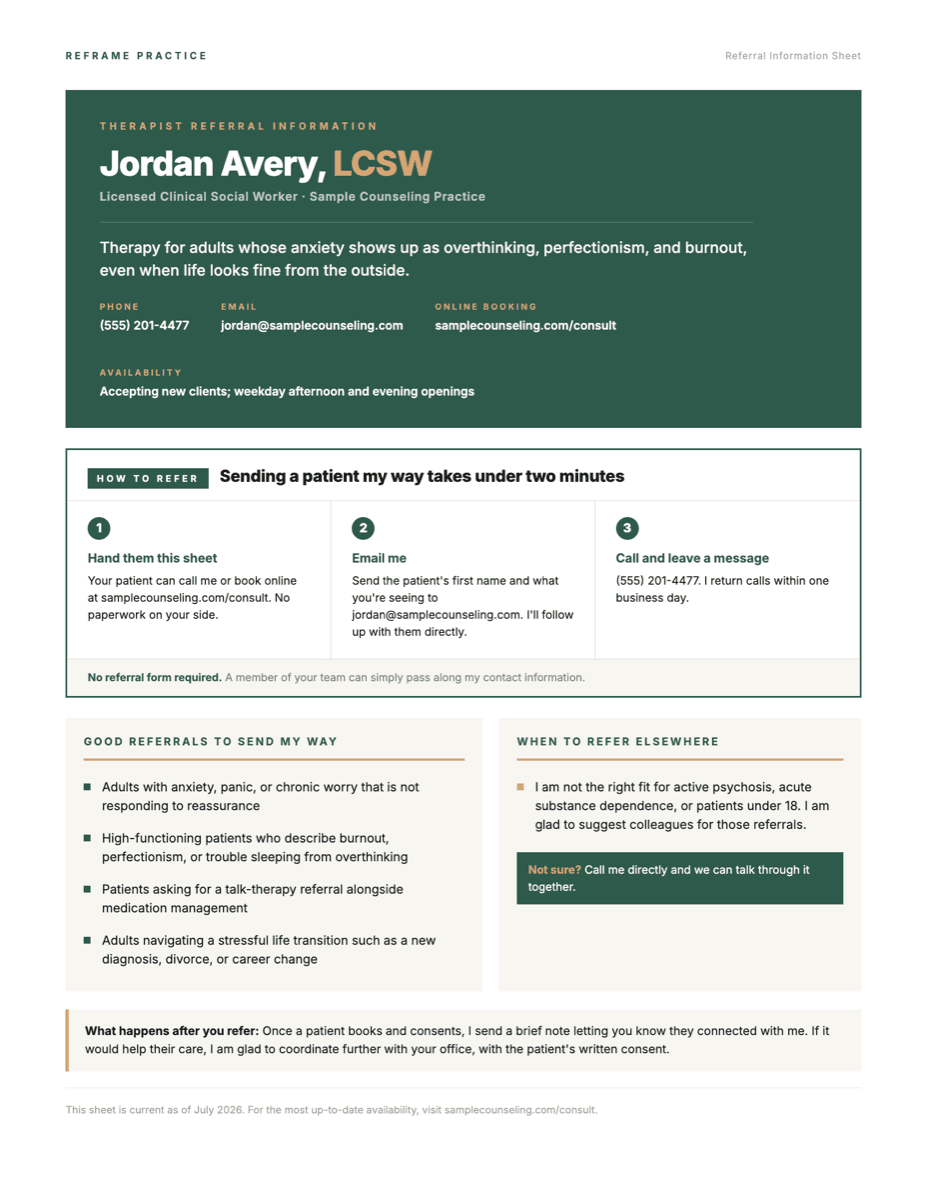
Jordan Avery is a worked example, not a real practice. Every piece in the kit comes with a filled-in example like this next to the blank version. And the one-pager is a structure, not a script: the language in your version comes from how you already describe your niche, your good-fit client, and your not-a-fit line. Jordan's version is here so you can judge the layout and the referral logic, not borrow her words.
The Referral Partnerships Starter Kit
That's what yours would look like, with your niche and your details. One email with the download, one short follow-up, done.
Free download. No spam. Unsubscribe anytime.
One thing up front
This channel is slow, and that's the point
Where this comes from: I built this after working through how referral relationships actually go in private practice. The awkward front-desk drop-off, the provider who sends people who are not a clinical fit, the thank-you note nobody sends and why that costs you the next referral. The pieces are written to handle those moments specifically.
The timeline: most write-ups skip this, so I'll say it plainly. I've spent enough time in this field to know that building local referral relationships tends to pay off over 6 to 12 months, not weeks. What's documented publicly lines up with that: therapists who've done it this way report their first referrals arrived months after the first visit, not days. The kit is built for that reality. If you want something faster, this isn't it.
The upside: these relationships keep working once they exist. And the doctors on the other side actually want this. In the conversations I've read, physicians say they refer patients to therapy constantly and are looking for reliable people to send them to. A provider who knows exactly who to send you keeps sending, quietly, for years. The kit just makes it easy for them to remember you.
The unknown: here's the part nobody can tell you, and the kit doesn't pretend otherwise: your own conversion rate. How many of those introductions actually turn into clients depends on your niche, how many providers near you serve it, and how saturated your area already is. The 6 to 12 month pattern is real. The exact number for your practice isn't something anyone can promise you up front.
The honest gap
Who am I even supposed to contact?
Fair question, and here's the straight answer. The free kit gives you every piece of writing you'll need, and it stands on its own. What it does not do is tell you which ten local offices to walk into. That research, finding the right offices for your niche and figuring out who the office manager is, is the slow part. If you'd rather not do that alone, the last page of the kit describes the version where I research your ten local targets and write your one-pager with you.
To be clear about what you're getting into: this is a one-time download with no subscription and no monthly program behind it. Nothing in the free kit requires the paid piece. It's complete on its own. Downloading it puts you on nothing beyond the kit email itself, which is one email with the kit and one short follow-up. That's it.
Three quick answers
Before you decide
Do I have to maintain this relationship myself, forever?
The follow-up rhythm is written down, not in your head. It tells you exactly when to check back, what to say, and when to stop. Three touches, then you are done unless the office reaches out.
Is there a subscription or program behind this?
No. One-time download, one email with the kit, one short follow-up. The paid option on the last page is a one-time piece of research and writing, not a retainer, and nothing in the free kit requires it.
What if I freeze at the front desk?
The script is word-for-word and short enough to read straight off your phone. You are dropping something off, not pitching. You read it, you hand over the sheet, you leave.
The Referral Partnerships Starter Kit
The one-pager, the intro letter and email, the front-desk script, the follow-up rhythm, and the thank-you and tracker pieces that keep a relationship going. Everything is already written, you fill in your details, and it's honest about how long this channel takes. By Jesse, Registered Psychotherapist.
Free download. No spam. Unsubscribe anytime.